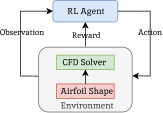
RL architecture for airfoil shape optimization.

Robust Aerodynamic Shape Optimization using Deep Reinforcement Learning and NIGnets

Advisor: Prof. Juan J. Alonso
Affiliation: Aerospace Design Lab, Stanford University

We design airfoils that achieve high Lift-to-Drag ratios.

We formulate aerodynamic shape optimization as a Deep RL problem. To tackle the problems caused by self-intersection produced during optimization we use NIGnets, a new neural architecture that we developed that gives a hard guarantee on non-self-intersecting geometry representation. A NIGnet as a whole with a particular setting of its weights and biases (denoted by $\phi$) represents a particular shape. Our shape optimization approach can be summarized as follows:

  1. Represent state (shape) using NIGnet parameters $\phi$.
  2. An action corresponds to outputting $\Delta \phi$ that perturbs the NIGnet parameters to $\phi' = \phi + \Delta \phi$.
  3. A reward is produced at each step that corresponds to the $\frac{L}{D}$ ratio of the current shape.

Since the NIGnet for any set of parameters $\phi$ always represents non-self-intersecting geometry, it will constrain the design space to only the set of physically reasonable shapes and therefore allow an RL agent to perform ambitious shape optimization. We also utilize Hindsight Experience Replay (HER) to train more general policies that can design for any target lift-to-drag ratio.
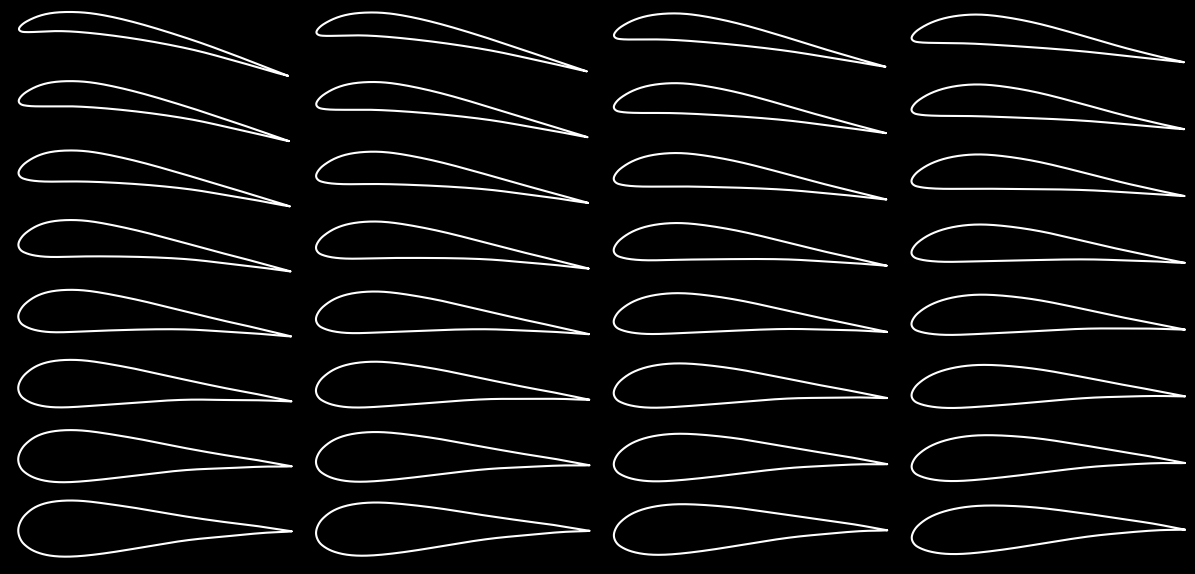
Bilinear interpolation of airfoils in a NeuralODE generative
                            model.

Robust Shape Optimization with Neural Shape Representations and Neural Operators

Advisor: Prof. Juan J. Alonso
Collaborator: Prof. Anima Anandkumar
Affiliation: Aerospace Design Lab, Stanford University

We design airfoils that achieve high Lift-to-Drag ratios.

Robust shape optimization using Neural Operators (FNOGNO, GINO, BNO) with geometry represented using NIGnets and NeuralODEs to prevent self-intersection and optimization over in-distribution shapes.

Generated Euler and RANS datasets with $\sim$20,000 simulations each using SU2 for 1500 airfoils at 16 different angles of attack. Trained Neural Operators to 2% accuracy on pressure field and skin-friction predictions.

Trained a NeuralODE based generative geometry model with hard guarantees on non-self-intersection. Achieved extremely accurate shape reconstruction loss of 1e-8 L2 on the entire shape dataset.

NIGnets logo with text inside.

NIGnets: Neural Injective Geometry Networks for Representing non-self-intersecting Geometry

Advisor: Prof. Juan J. Alonso
Affiliation: Aerospace Design Lab, Stanford University

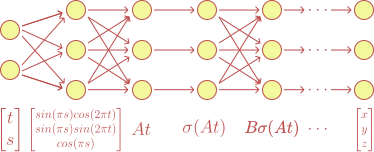
Existing deep geometry representations do not have the right priors for aerodynamic design optimization, they often fail to mesh and represent excessively large and irrelevant design spaces. This leads to brittle and inefficient design space exploration. We solve this problem by introducing Neural Injective Geometry networks (NIGnets), a new neural architecture that parameterizes injective and closed transformations, allowing us to represent only simple closed curves and surfaces. This enables design optimization procedures working with NIGnets to perform unconstrained optimization on the network weights while maintaining the non-self-intersection property, thereby guaranteeing water-tight meshes. We also compare the representation power and inference speed of NIGnets with normalizing flow models that can potentially offer similar geometric guarantees.